
- >> Common Research Facilities
-
Fundamental Technology Center
Researcher

- [ Director, Professor ]
Shigeo Sato - [ Technical Staff ]
Tamotsu Suenaga - [ Technical Staff ]
Yuko Maruyama - [ Technical Staff ]
Rikima Ono - [ Technical Staff ]
Maho Abe - [ Technical Staff ]
Takenori Tanno - [ Technical Staff ]
Hiroyuki Yagyu - [ Technical Staff ]
Kento Abe - [ Technical Staff ]
Kenji Ota - [ Technical Staff ]
Michimasa Musya - [ Technical Staff ]
Iori Morita - [ Technical Staff ]
Yasuaki Maeda - [ Technical Staff ]
Kana Tsukimoto
Visit Fundamental Technology Center Web Site
- Providing of technical skills of machining, physical and chemical measurements, device processing, and information management
- Maintaining of the in-house network of the institute
- Technical supports for safety and security of the institute
Pioneering studies in research areas from basic sciences to applied communication technologies have been performed at this institute. Technical staffs have traditionally contributed to these efforts through the use of their well-established skills, experience, and knowledge. To accelerate such contributions in the future, a fundamental technology center encompassing all technical staffs and an assistant professor was established in 2007. This center provides technical skills of machining, physical and chemical measurements, device processing, and information management through the following four divisions.
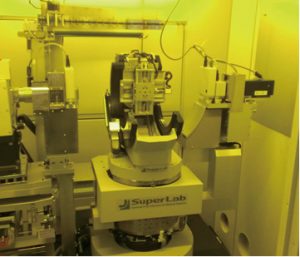
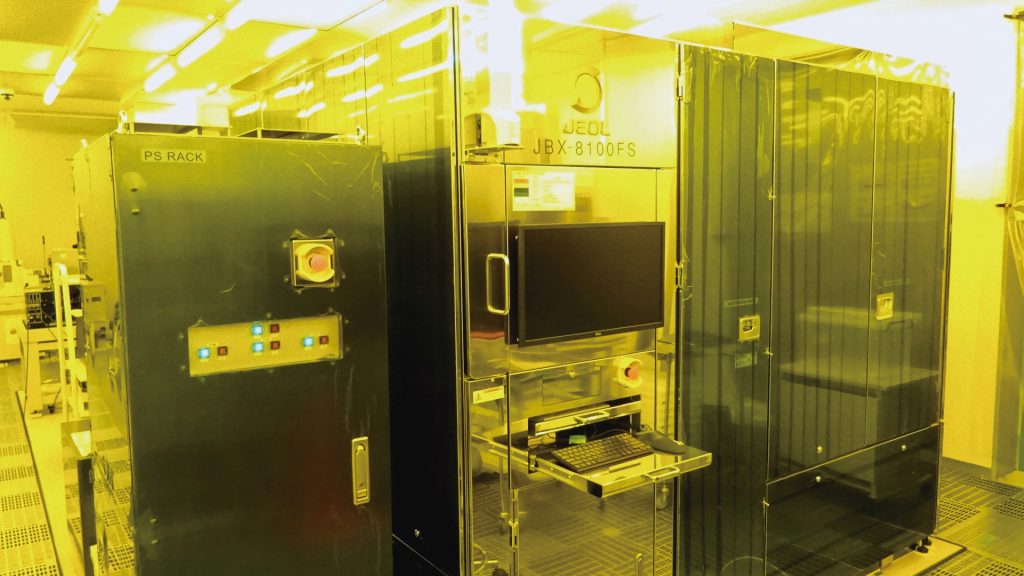
The machine shop division focuses on advanced machining techniques and supplies the experimental apparatus that are required by different laboratories by various machine tools (e.g., see Fig.1). This division also provides machining instructions to the students and faculty members who pursue machining independently. The evaluation division offers various evaluation and measurement instruments such as X-ray diffractometer (see Fig.2) and electron probe X-ray micro analyzer. Glass processing techniques can also be provided. In addition, this division is responsible for supplying cryogen. The Process Division provides technical consultation and process support for the fabrication of semiconductor and nanostructured devices in collaboration with the cooperation section of the Laboratory for Nanoelectronics and Spintronics. The division offers advanced micro- and nanofabrication technologies, including electron beam lithography, photomask processing, and ion-beam processing. Electron beam lithography (see Fig. 3) is positioned as a core technology for nanoscale device fabrication and has demonstrated sub-10 nm patterning capability. These technologies support the fabrication of fine structures for research in fields such as spintronics, nanophotonics, and quantum devices. The division also supports the shared use of fabrication equipment and commissioned processing services, and provides technical support for the operation of cleanroom facilities and beam-based processing technologies. Finally, the information technology division operates the in-house network of the institute and manages commonly used information equipment in cooperation with the Flexible Information System Center. In addition, this division engages in the collection and management of intellectual property-related information.